
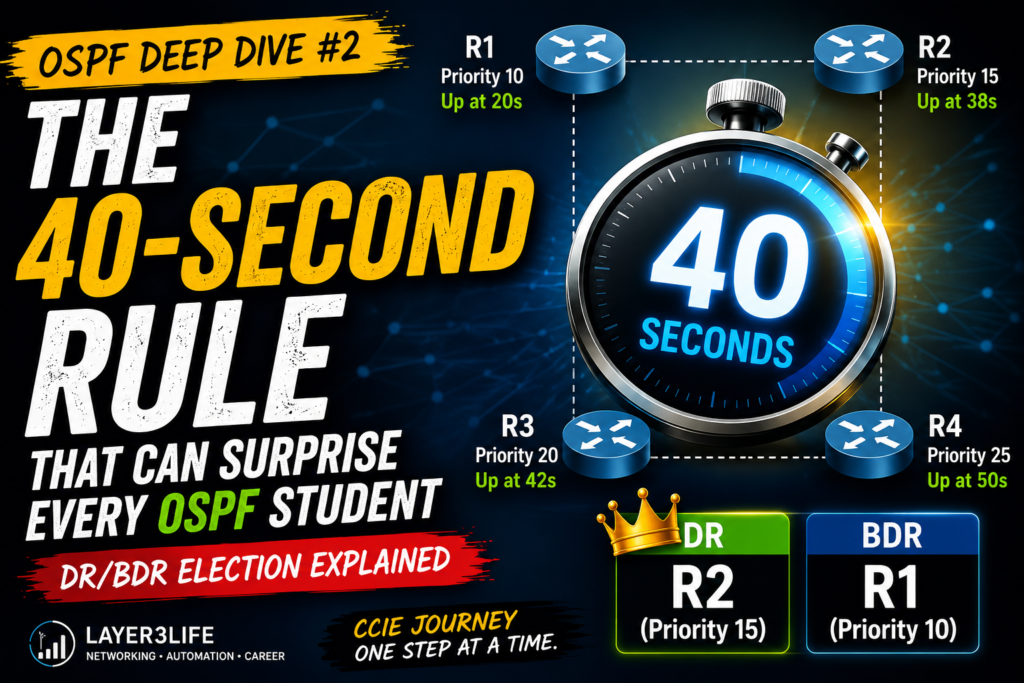
The 40-Second Rule That Can Surprise Every OSPF Student
Part of my CCIE Enterprise Infrastructure Journey
One of the first things we learn about OSPF Designated Router (DR) and Backup Designated Router (BDR) election is simple: the router with the highest OSPF priority wins. If there’s a tie, the router with the highest Router ID becomes the winner.
Another important detail that’s easy to overlook:
Being the highest priority router isn’t enough—you also have to be there when the election happens.
The 40-Second Election Window
On an Ethernet network (Broadcast Multi-Access), OSPF doesn’t immediately start exchanging routing information when a router boots up.
Instead, routers enter a 40-second Wait State. During this period, they exchange Hello packets and determine which routers are participating in the DR/BDR election.
Think of it as waiting for everyone to enter the meeting room before voting begins.
Once the 40 seconds expire, the routers that were already online participate in the election based on:
- Highest OSPF Priority (0–255)
- Highest Router ID (if priorities are equal)
After the election is complete, normal OSPF operation begins.
Example Scenario
Imagine four routers connected to the same Ethernet segment.
| Router | Priority | Boot Time |
|---|---|---|
| R1 | 10 | 20 sec |
| R2 | 15 | 38 sec |
| R3 | 20 | 42 sec |
| R4 | 25 | 50 sec |
At first glance, you might expect:
- DR → R4
- BDR → R3
After all, they have the highest priorities.
But here’s the catch.
Only R1 and R2 came online within the initial 40-second election window.
That means the election only considers those two routers.
Election Result
- 🏆 DR → R2 (Priority 15)
- 🥈 BDR → R1 (Priority 10)
R3 and R4 join the network after the election has already finished. Since OSPF DR/BDR election is non-preemptive, they do not replace the existing DR or BDR, even though they have higher priorities.
Why Does OSPF Do This?
Ethernet is a Broadcast Multi-Access network, meaning multiple routers can share the same segment.
If every router formed a Full adjacency with every other router, the number of neighbor relationships would grow rapidly as more devices were added.
To reduce unnecessary LSAs and adjacency overhead, OSPF elects a Designated Router (DR) and a Backup Designated Router (BDR) for each broadcast segment.
Instead of everyone talking to everyone, routers primarily exchange LSAs through the DR, making the network much more scalable.
Quick Notes
- OSPF elects a DR/BDR only on multi-access networks such as Ethernet.
- Election is based on Priority, then Router ID.
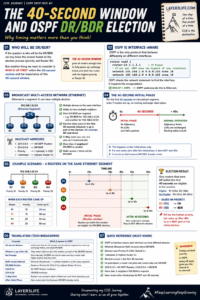
- Only routers present during the initial 40-second Wait State participate in the first election.
- OSPF DR/BDR election is non-preemptive.
- A router joining later will not replace the existing DR or BDR unless the current DR or BDR fails.
- Multicast addresses:
- 224.0.0.5 — All OSPF Routers
- 224.0.0.6 — DR and BDR
Final Thoughts
One lesson I’ve learned while preparing for the CCIE is that understanding why OSPF behaves the way it does is much more valuable than simply memorizing commands.
The next time someone asks, “Who becomes the DR?”, don’t just look at the priority. Also ask:
“Was the router even there during the first 40 seconds?”
Sometimes, in networking as in life, showing up early makes all the difference.